
What Is Local-First Storage? A Plain-English Guide for Private Journals
Local-first storage means your device keeps the primary copy of your data. The app may still offer sync, backup, sharing, or AI features, but your records do not begin their life as something that only exists on a company server.
That sounds technical, but the practical question is simple: if the internet disappears, the vendor has an outage, or you decide to leave the product, can you still open your own data?
For a private journal, that question matters more than almost any feature checklist.
Memex
Try a local-first AI journal
Download Memex, capture one real moment, and keep your journal archive portable from the beginning.
Follow the local-first path
Use this page as the definition, then continue into privacy, offline use, open source, and AI model routing.
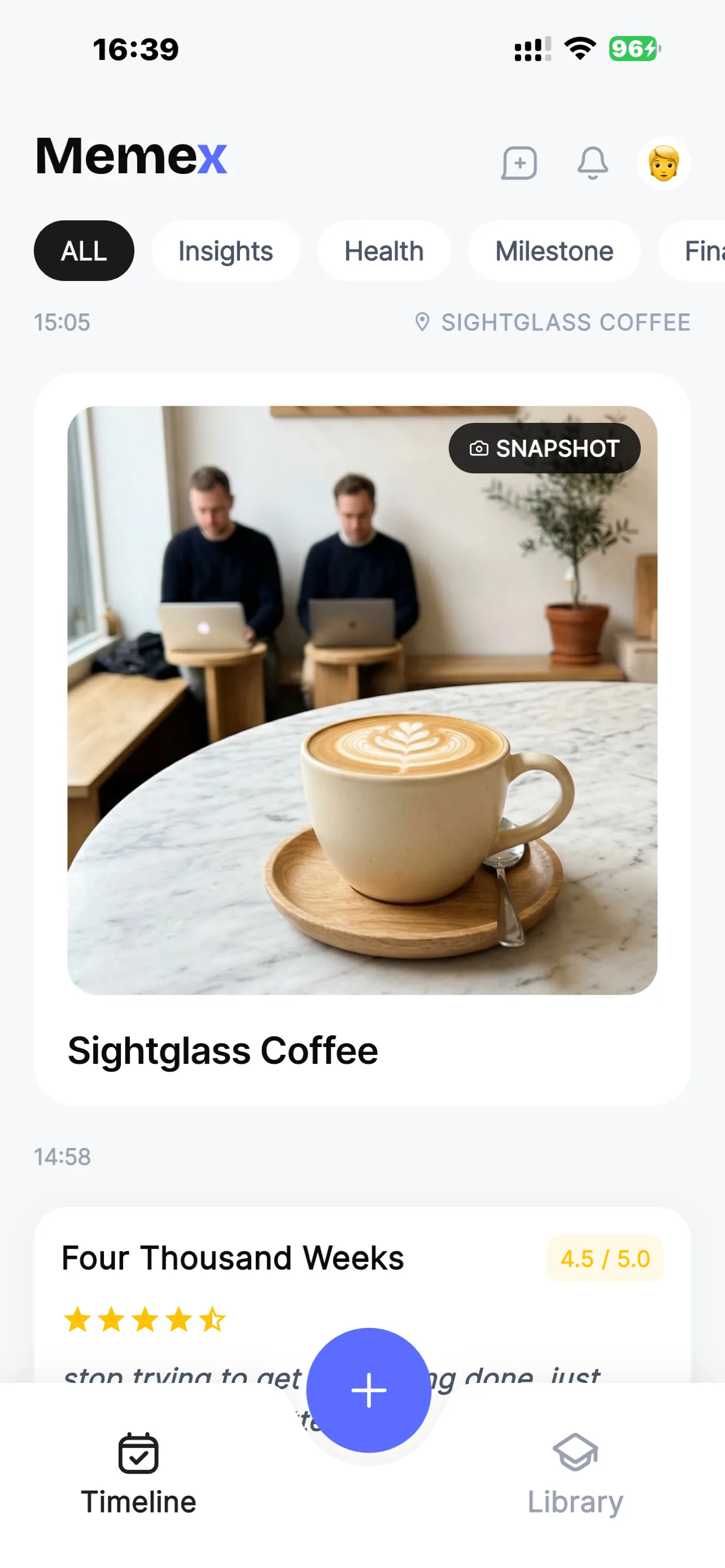
Local records, organized context
What is local-first storage?
Local-first storage is an application design where the user's device is the source of truth for the data. When you write a note, save a photo, or record a journal entry, the original record is stored locally first. Network features are layered on top.
The phrase comes from the broader local-first software movement, especially the work of Ink & Switch. Their core idea is that software should combine the convenience of cloud apps with the ownership, longevity, and offline resilience of files on your own computer.
A local-first app can still connect to the cloud. It can sync between devices. It can make backups. It can use AI providers. The difference is that those services are not the only place your data lives.
Local-first vs cloud-first vs offline-first
These terms overlap, so separate two questions: where is the primary copy, and what still works without a connection?
| Storage model | Primary copy | Offline behavior | Journal risk |
|---|---|---|---|
| Cloud-first | The company server | Usually limited to cached data | Your archive depends on the vendor account, server, and export path. |
| Offline-first | Varies by app | The app keeps working without a connection | Offline use is good, but ownership is unclear if the cloud is still the source of truth. |
| Local-first | Your device | Core writing, reading, and storage work locally | You still need a backup plan, but the original record is under your control. |
Why local-first storage matters for journals
Journals are unusually sensitive. They contain private thoughts, health details, relationship context, raw emotions, photos, audio notes, and the half-finished ideas you may not want anyone else to interpret.
Local-first storage changes the trust model. Instead of asking whether a company will always protect your journal, you can ask where your journal file is and whether you can keep using it if the service changes.
It also improves durability. A journal should last longer than a subscription cycle. Local files and local databases have a better chance of surviving app redesigns, pricing changes, outages, acquisitions, and shutdowns.
Memex
Try a local-first AI journal
Download Memex, capture one real moment, and keep your journal archive portable from the beginning.
What local-first storage does not automatically solve
Local-first is not magic. It does not remove every security responsibility, and it does not mean your data is automatically backed up.
- You still need backups. Local-first gives you ownership; backup gives you recovery.
- Sync still needs design. Multi-device sync can create conflicts, so the app needs a clear merge strategy.
- AI may still use a provider. If you choose a cloud model, prompts may leave the device unless the app supports local models or local providers.
- Device security matters. A local archive should be protected by the operating system, app permissions, and sensible export choices.
How local-first storage changes AI journaling
AI journaling raises the stakes because the app is no longer only storing entries. It may transcribe audio, summarize days, cluster memories, search across photos, and infer patterns from private context.
In a cloud-first AI journal, the simplest architecture is to send more data to the company's backend and let the backend coordinate everything. That can be convenient, but it creates a large trust surface.
In a local-first AI journal, the app can keep the record archive local while letting the user choose which AI tasks happen on-device, which go to a selected provider, and which should not happen at all.
How Memex thinks about local-first storage
Memex is built around a local-first journal model: capture should work on the phone, records should remain useful without the network, and AI should organize life context without turning the company server into the center of the archive.
That is why Memex pairs local storage with exportable records, on-device workflows where they make sense, and bring-your-own-model options for people who want more control over AI routing.
Local-first apps · Offline journal app · Private AI journal app · Open-source journal app
How to tell if an app is really local-first
Product pages often use words like private, secure, offline, encrypted, and local. Those words are useful only if they answer concrete questions.
- Can I create and read entries with no internet connection?
- Does the app say where the primary copy of my data lives?
- Can I export my journal in a readable format such as Markdown, JSON, SQLite, or plain files?
- Are sync, backup, and AI providers optional choices rather than invisible requirements?
- If the company shuts down, can I still open my journal without asking the company for permission?
FAQ
Is local-first storage the same as offline storage?
No. Offline storage means an app can keep working without internet. Local-first storage also answers the ownership question: the authoritative copy starts on your device, not only on a remote server.
Does local-first mean no cloud sync?
No. A local-first app can still offer sync, backup, and collaboration. The difference is that those features replicate or protect local data instead of replacing it as the main source of truth.
Why does local-first storage matter for journals?
A journal contains private, long-lived records. Local-first storage keeps the core archive closer to the person who created it, makes export easier, and reduces dependence on a vendor server for basic access.
Local-first storage is not just a developer architecture term. For a journal, it is the difference between renting access to your life archive and keeping the original records close enough that you can still trust them later.