
Free Online Journal in 2026: What People Actually Want
By Jason · Editorial review
Imagine someone opening a laptop at 11:48 p.m. They do not want to design a perfect diary system. They just want to write one sentence before the day disappears: "I felt calmer after the walk." Then tomorrow it might be a photo, a quick voice note, or nothing at all.
That is what many people really mean when they search for a free online journal, free online journals, or simply a free journal. They are not shopping for a fancy writing ritual. They are looking for a low-pressure place to put small pieces of life before those pieces are gone.
Try a low-friction journal
Download Memex and start with one tiny record
Capture text, photos, and voice in a local-first AI journal, then turn small moments into a searchable life timeline.
| What people want | Weak version | Strong version |
|---|---|---|
| Start quickly | Blank page plus signup friction | Capture immediately, with or without an account |
| Keep private thoughts private | Vendor server is the default source of truth | Clear local ownership or explicit privacy model |
| Use it across devices | One-device diary or fragile export path | Cross-device access without trapping your archive |
| Actually keep journaling | Long text-only entries every time | Photos, short notes, voice, and low-friction capture |
| Find things later | A pile of entries you never revisit | Search, structure, and summaries that make old records usable |
What people actually mean by free online journal
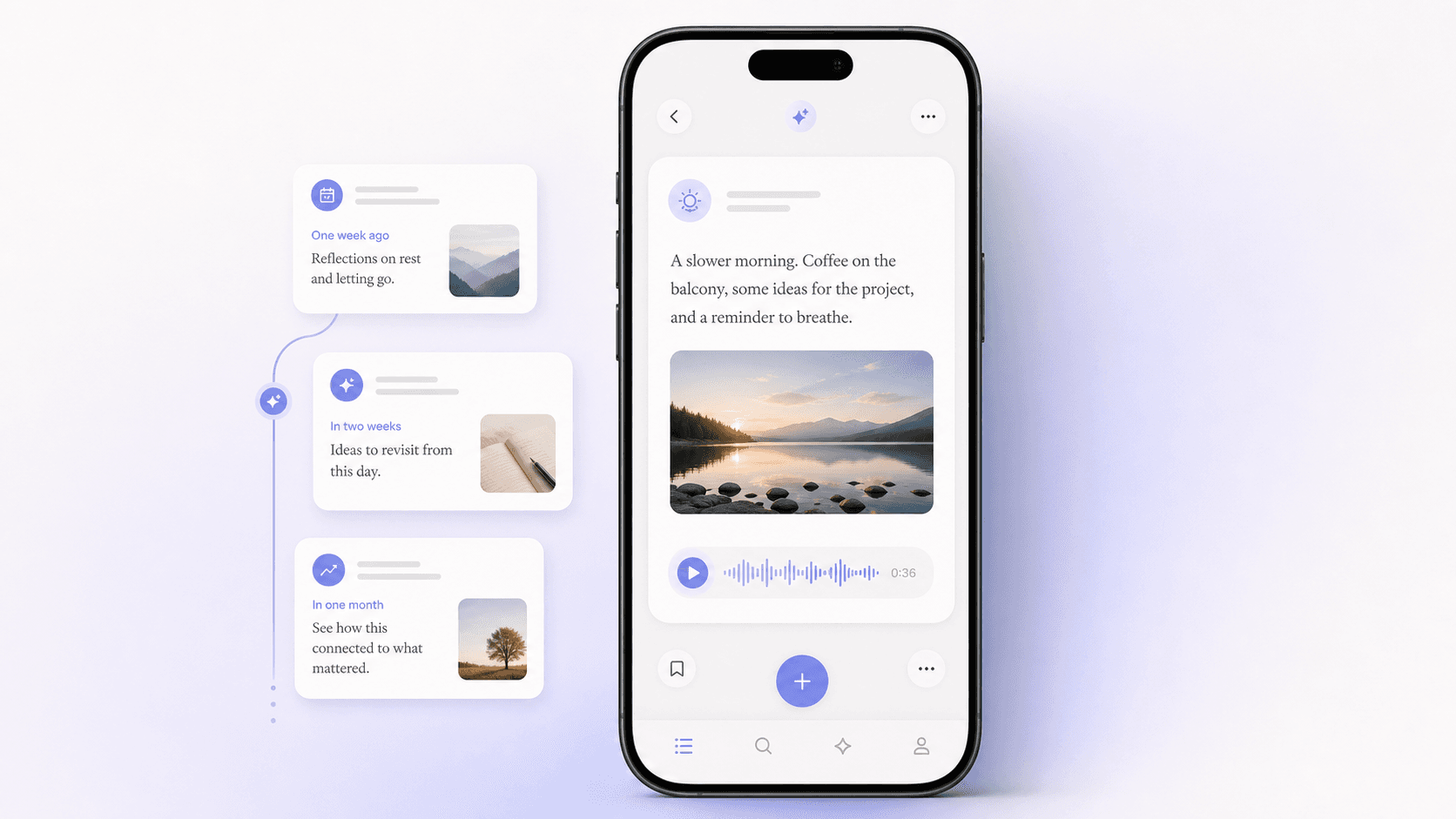
Search behavior around this topic is broader than it first appears. Some users want a classic web diary. Others want a journal app without an account. Some want 365 day journal prompts. Some want full journal software that can understand photos, voice, reminders, and context. Some are really choosing a mobile home, such as an Android journal app or an iOS journal app. Some want privacy. Some want something that works on iPhone, iPad, Mac, and browser without becoming another abandoned productivity tool.
- Can I start without commitment? Free means low-risk first use.
- Can I use it anywhere? Online means accessible across contexts.
- Will my writing stay mine? Personal records create privacy pressure.
- Will this still help me later? A journal that you never revisit is only half useful.
A person may start with "free online journal" because it sounds simple, then quickly discover adjacent questions: should this be a private AI journal? Should it work as an offline journal app? Can it hold photos like a photo journal app? Can it accept voice the way an audio journal app does?
Free online journals vs a free journal app
The plural search free online journals usually signals comparison mode. People are not asking for one blank page; they want to know which free journal will still feel usable after the first week.
- Browser-first journals are useful when you mainly write from a laptop or shared devices.
- Mobile journal apps are better when most records start as photos, voice notes, short thoughts, or reminders.
- Local-first journals are worth considering when privacy, export, and long-term ownership matter more than a purely cloud-based web diary.
If your search for a free journal is really about a phone habit, compare the iPhone journal app and Android journal app guides before choosing a generic online diary.
Why so many free online journals fail after the first week
The usual failure mode is not that people stop caring about journaling. It is that the tool asks for too much structure too early. You open it with a messy moment or one small memory, and the product expects a clean entry.
- Blank-page pressure: users feel like every entry should be meaningful.
- Text-only assumptions: photos, short notes, and voice are treated as second-class.
- Server-first trust: the journal begins with account creation, not capture.
- Weak revisit value: old entries are stored, but not organized or surfaced well.
The first week is usually the test. On Monday, the user writes a paragraph. On Tuesday, they only save a photo. On Wednesday, they talk for 20 seconds while walking home. By Friday, the journal either accepts that messy rhythm or quietly becomes another app they feel guilty about ignoring.
Online journal vs free journal app
An online journal is usually a place you can open from a browser or multiple devices. A free online journal adds low-risk first use. A free journal app may feel less web-first, but it can be better if the real need is fast phone capture, photos, voice notes, offline access, and export.
That matters because many searches for "online journal" are not really asking for a blank web page. They are asking for a private, searchable place to keep life records. If you mostly journal from an Android phone, read the best journal app for Android guide, or use the same checklist when comparing any diary app for Android. If you are comparing AI features, privacy, and price, use the best AI journal apps comparison.
Free matters, but friction matters more
People often say they want free, but the stronger signal is low friction. If the journal is free but hard to open, hard to trust, or hard to keep using, the price does not save it.
- Free to try: no heavy setup before the first useful moment.
- Free to keep using: capture stays easy when life gets messy.
- Free to leave: export is possible and your archive is not trapped.
If you are comparing free tools, also check whether the app is open about its data model. A free plan is less comforting if the product is vague about export, account requirements, or whether your entries become input for AI training. The companion guide on journal apps and AI data training walks through that risk.
Online does not have to mean cloud-first
One of the biggest confusions in this category is the assumption that online journaling must mean server-first journaling. It does not. Some people want a browser app. Others want a local-first journal that can still appear across devices.
If privacy matters, this distinction is worth slowing down for. A cloud-first journal often treats the company backend as the primary home of your records. A local-first journal can still feel online from the user's perspective while keeping the trust model much clearer.
- Where does the original entry live?
- Do you need an account before capture starts?
- Can you export without losing structure?
- Are photos, voice, and short notes supported, or only long-form text?
- Does the app help you find things later, or only store them?
For a deeper version of that checklist, read the guides on AI journal privacy, local-first apps, and open-source journal apps.
What makes a free online journal worth keeping
First, it makes capture tiny. The journal should be able to hold a sentence, a photo, a voice note, or a quick reflection. If everything must become a full entry, most days get lost.
Second, it makes retrieval real. A good journal is not just storage. It becomes a place where patterns, memories, and life details can be found later.
Third, it makes trust legible. Users should not need a forensic audit to understand whether the app is account-first, cloud-first, or export-friendly.
That is the shift from "I wrote something" to "I can find my life again." The same idea appears in the guide to turning fragmented notes into a searchable life record: the raw material can stay casual, but the system around it should make it useful later.
Where Memex fits
Memex is not trying to be a minimal browser diary. It is closer to a local-first memory system that still supports low-friction journaling. You can capture small records, use photos and voice, and later search or revisit what would otherwise become scattered fragments.
That means it fits best for people who are searching for a free online journal but really want something slightly more ambitious: a journal that works across devices, stays private by default, and becomes more useful as records accumulate. If your needs are more visual, the journal app with photos guide is the best next step. If your main concern is trust, start with journal app without an account.
You can try Memex on the App Store, the China App Store, or Google Play. If you want to inspect how the app works, the Memex GitHub repository is open source, and the Discord community is the best place to share feedback.
Final thought
The phrase free online journal sounds like a commodity search, but the decision is really about capture, trust, and long-term usefulness. The best option is the one you will still trust enough to use, and still be able to learn from, six months later.
FAQ
What is an online journal?
An online journal is a digital journal you can access from a browser, cloud account, or connected app experience. The best online journal is not only easy to open; it should also be private, searchable, exportable, and comfortable for short notes, photos, or voice capture.
What is the best free online journal?
The best free online journal depends on what you mean by online. Some people want a simple web diary they can open anywhere. Others want a local-first journal that can still sync across devices. The strongest options keep capture easy, do not trap your data, and stay useful after the first week.
Is a free online journal better than a free journal app?
A free online journal is better if you mainly want browser access and simple writing. A free journal app is better if you journal from your phone, want offline capture, photos, voice notes, reminders, and stronger control over where private records live.
Are free online journals private?
Not always. A free online journal may still require an account, store your entries on a vendor server, or send prompts to cloud AI services. If privacy matters, check where the original journal lives, whether export is easy, and whether the app can work without making the company backend the center of your archive.
Can I use a free online journal on iPhone, iPad, and desktop?
Yes, but the implementation differs. Some tools are browser-first and depend heavily on a server account. Others are local-first apps with sync options. What matters is whether capture feels fast on mobile and whether your entries stay accessible across devices without locking you into one platform.
Can I use an online journal without an account?
Some journal apps let you start without an account, especially local-first tools. That is useful for privacy and habit formation because the first step is capture, not signup. If accountless use matters, also compare journal apps without an account before choosing a web diary.
Does journaling have to mean writing long entries?
No. For many people, photos, short notes, and voice capture work better than blank-page writing. A good journal makes it easy to record something small now and make sense of it later.